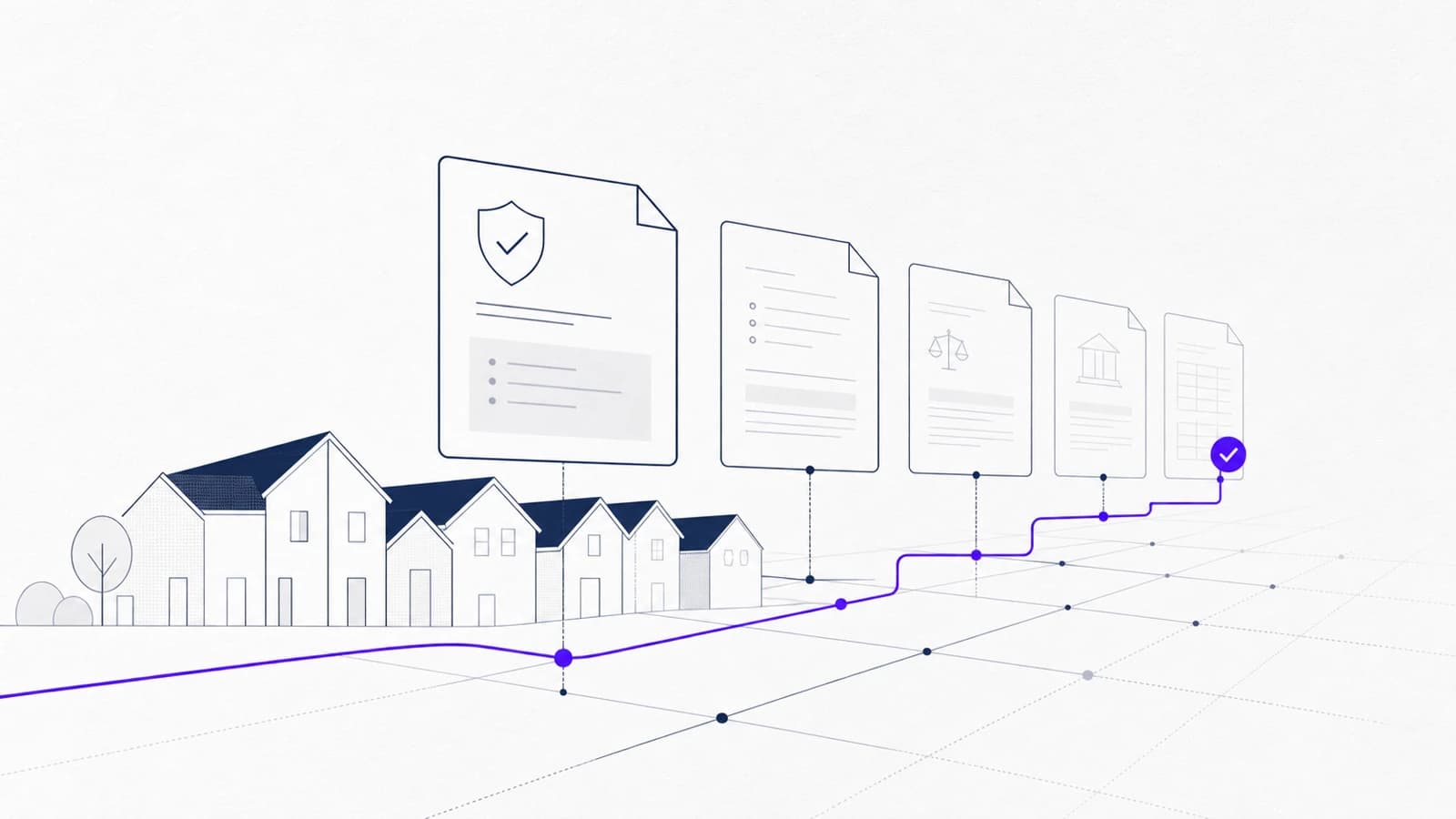
A predictive model scores a tenant's damp report as low risk, and nobody visits. An arrears engine flags a household for escalation the week a carer's benefit changes. A chatbot logs a repair at midnight, and the record never reaches a surveyor. Each of these decisions is already being made inside English social housing — and each lands on a tenant who usually cannot take their business elsewhere.
That is the governance problem in one sentence. AI is arriving through repairs triage, damp and mould prediction, arrears early warning and complaint handling — often inside supplier systems the board has never independently tested — while accountability for every outcome stays where it always was: with the board. This is the playbook we use when working with housing association boards: where the technology is landing, what the Regulator of Social Housing and the Housing Ombudsman will expect a board to evidence, and the controls to require before deployment, not after.
Key takeaways
- Nearly half of housing associations use AI day to day, yet 44% have no AI policy and 87% report low knowledge of it, per the National Housing Federation's 2025 research.
- Awaab's Law has carried fixed statutory timescales since 27 October 2025; a model that wrongly deprioritises a damp report does not stop the clock.
- The four consumer standards and the statutory Complaint Handling Code make the board answerable for algorithmic outcomes; a supplier contract does not transfer that accountability.
- Predictive scoring of tenants engages the Equality Act 2010 and UK GDPR's new Articles 22A–22D rights to human review and contest, in force since 5 February 2026.
- The Ombudsman decides cases on records. "The algorithm said so" is not an explanation; it is an admission that you cannot reconstruct the decision.
Where AI is actually arriving in social housing
The National Housing Federation's State of AI in Housing 2025 research found 47% of responding housing associations already using AI in day-to-day operations — while 87% reported low knowledge of AI and 44% had no AI policy in place (NHF, October 2025). Adoption is running ahead of literacy, and literacy ahead of policy — precisely the gap a board exists to close.
If that policy gap is the live issue, use the companion AI policy template for housing associations to turn the board's oversight decision into clauses, evidence and owners.
In practice, the technology is arriving at four points:
- Repairs triage and damp and mould prediction. Stock condition data, repair histories and sensor feeds predict which homes will develop damp and mould and which repair reports deserve priority. The NHF's sector casework shows some associations adopting these tools deliberately — and others because the housing management supplier switched the feature on.
- Arrears early warning. Payment patterns and benefit cycles are scored to flag households likely to fall behind. Built for early support, these systems drift toward enforcement the moment a flag starts triggering letters instead of phone calls.
- Complaint handling. Drafting responses, categorising cases, summarising files — and, on the other side of the desk, residents using AI to write complaints. The Risk Register Survey 2026 — an analysis of 100 housing associations' 2024/25 accounts — reports residents' use of AI in complaints "increasing dramatically" (Capsticks, January 2026).
- Tenant communications. Chatbots and triage assistants increasingly sit at the front door of the service — the first place a hazard gets reported.
Risk registers have not caught up: the same survey found cyber security the most-named risk for a third year (84%), while AI appears only as an emerging risk rather than a current strategic one. For a technology already making decisions about tenants, "emerging" is generous.
Why the stakes are higher here than in most sectors
Social housing concentrates everything that makes automated decision-making dangerous: tenants who cannot exit, high vulnerability, and decisions that touch health and safety directly. Four regimes turn that weight into legal exposure.
Awaab's Law sets statutory clocks your model cannot pause. Since 27 October 2025, social landlords must investigate significant damp and mould hazards within 10 working days, issue a written summary of findings within 3 working days of the investigation concluding, and investigate and make safe emergency hazards within 24 hours (MHCLG guidance for social landlords). The regime is due to extend during 2026 to excess cold and heat, falls, fire and electrical hazards, and in 2027 to nearly all HHSRS hazards. A model that scores a genuine hazard as low risk has not made a "model error"; it has set up a statutory breach, because the timescales run from awareness of the hazard, not from the model's opinion of it.
The consumer standards make fairness inspectable. Since 1 April 2024 the four consumer standards — including Safety and Quality and Transparency, Influence and Accountability — apply to all registered providers, enforced through proactive inspection (RSH regulatory standards). If an algorithm decides whose repair comes first or whose arrears case escalates, those are consumer-standard outcomes produced by a system the board is expected to control.
Predictive scoring engages the Equality Act 2010. Arrears and repairs models learn from proxies — postcode, household composition, payment history, communication patterns — and those proxies correlate with protected characteristics. A model that systematically deprioritises certain households risks indirect discrimination, whether or not anyone intended it. The defence is testing, not intention.
Data protection law has just been rewritten around exactly this. Section 80 of the Data (Use and Access) Act 2025 came into force on 5 February 2026, replacing the old Article 22 of the UK GDPR with new Articles 22A–22D (ICO). Where automated decisions are significant — arrears escalation and allocations plainly qualify — tenants keep the rights to be told, to obtain human review and to contest the decision. Those rights are design requirements, not privacy-notice paragraphs.
What the regulator and the Ombudsman will expect a board to evidence
The Governance and Financial Viability Standard requires the board to hold effective control and assurance over how the organisation is run. An AI system shaping tenant outcomes that the board has never reviewed is a control gap in those terms — the kind an inspection can convert into a governance downgrade. The evidence an inspector will want is unglamorous: a register of where AI operates, including supplier platforms; a named owner for each use; proof that fairness and accuracy claims were tested; regular reporting. In other words, a working AI governance framework, not a one-page policy signed in a hurry.
The Housing Ombudsman's expectations point the same way. The Complaint Handling Code became statutory on 1 April 2024, with a statutory duty to monitor compliance and an annual self-assessment scrutinised at governing-body level (Housing Ombudsman, February 2024). The Ombudsman has also been explicit that casework lives or dies on records, calling knowledge and information management "the closest thing to a silver bullet" for the sector's failings (Housing Ombudsman, May 2023). Every AI system you deploy either strengthens that record or quietly corrodes it.
Use case, key risk, and the control a board should require
| Use case | Key risk | Control the board should require |
|---|---|---|
| Damp and mould prediction | False negative becomes an Awaab's Law breach; missed hazards cluster in particular stock or households | The model prioritises but never closes a case; every tenant report still starts the statutory clock; sample "low risk" scores audited against inspection findings |
| Repairs triage | Vulnerable households deprioritised by data that does not capture vulnerability | Vulnerability flags as mandatory model input; a recorded human override route; published repair standards the model cannot quietly relax |
| Arrears early warning | Support tool drifts into automated enforcement; proxy variables produce Equality Act exposure | A human decision, logged with a name, before any enforcement step; reason codes for every flag; outcome monitoring across protected characteristics |
| Complaint handling | AI-drafted responses misstate facts or miss Code timescales | Human sign-off on every response; the record shows what was AI-drafted; Code compliance reported to board unchanged by the tooling |
| Tenant chatbots | A hazard reported to the bot is legally a hazard reported to the landlord | Hazard keywords escalate to a human immediately; full transcripts retained; chatbot contact feeds the same system the Awaab's Law clock runs on |
The pattern in all five rows: the model may inform the decision, but a named person remains the decision-maker, and the record proves it.
Why "the algorithm said so" fails in front of the Housing Ombudsman
Picture the determination. A tenant reported damp three times; the model scored the property low risk; the visits never happened; the family's health suffered. The Ombudsman asks the landlord to explain itself. The honest answer — "our system deprioritised it" — fails for three reasons.
First, the Ombudsman tests whether the landlord acted reasonably on the information it held. A risk score is information the landlord held. If you cannot produce the model version, the inputs, the threshold and who saw the output, you cannot show your handling was reasonable — you can only show that a process you did not understand produced an outcome you did not check.
Second, the model's knowledge is your knowledge. A board should assume a hazard reported to its chatbot, or visible in its own predictive data, is one the organisation is aware of. The statutory clock does not wait for a human to read the transcript.
Third, outsourcing does not relocate blame. Maladministration findings name the landlord, not the software vendor, and they are published. The supplier's accuracy claims are marketing until your own assurance has tested them.
Questions for the next board meeting
- Where is AI already operating — including inside supplier systems for housing management and repairs — and who owns the complete list?
- For each use, what decision does it influence, and can a tenant reach a human with authority to override it?
- If our damp and mould model scores a report wrongly, who finds out, how fast — and does the Awaab's Law clock keep running meanwhile?
- What data feeds our arrears and repairs scoring, and when did we last test outcomes across protected characteristics?
- Could we reconstruct any individual AI-influenced decision for the Ombudsman tomorrow — inputs, output, model version, human sign-off?
- Which consumer standards would an inspection test our AI use against, and what evidence would we put on the table?
These are the sector-specific six; the fuller set is in our companion piece on the questions every UK board should ask about AI. For a fast, structured read on where your organisation stands, the Board AI Scorecard takes about ten minutes.
None of this is an argument against the technology. A damp prediction model that works — governed, tested and acted on — is the kind of tool that could prevent the next tragedy rather than explain it. The argument is narrower: in a sector where tenants cannot walk away, the board must be able to show its working. The organisations that can will use AI with confidence. The ones that cannot will discover the gap in a published determination.
Last reviewed: 12 June 2026.
If your board wants an independent picture of where its AI exposure sits — against the consumer standards, Awaab's Law and the Ombudsman's evidential expectations — our AI governance diagnostic (from £3,950) is built for that. Start with the Board AI Scorecard, or see how we work with housing associations.