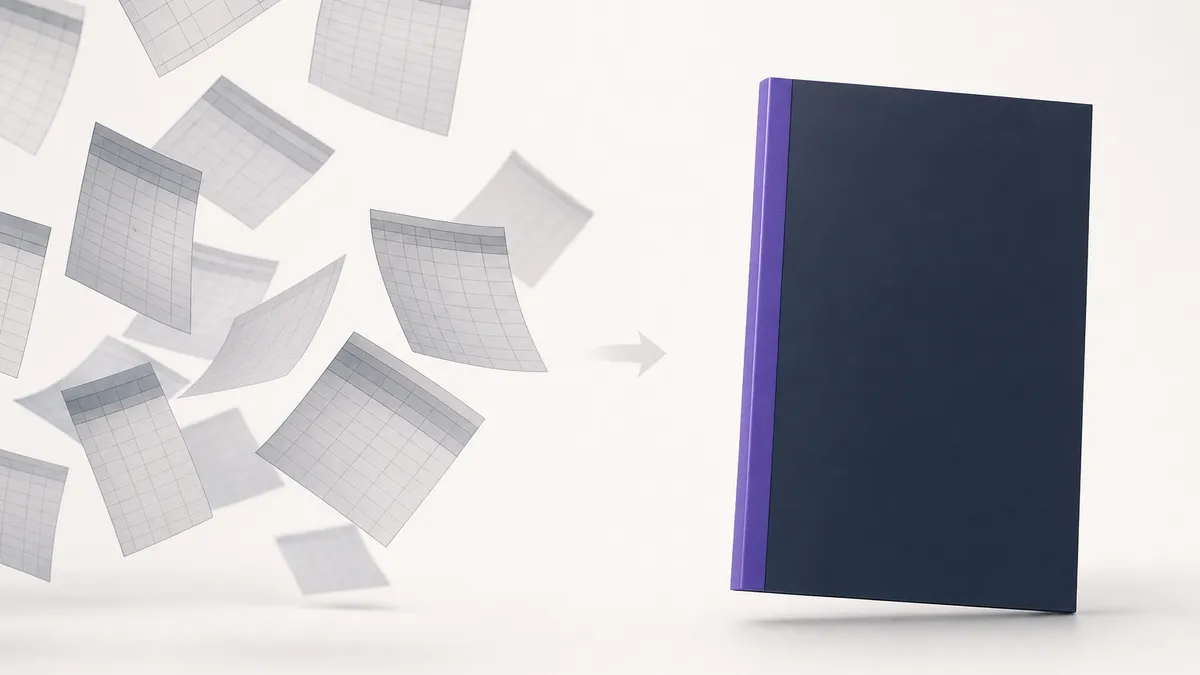
You replace Excel with custom software when the spreadsheet has stopped being a tool and become a system of record it was never built to be — when a critical process depends on a workbook that no one can fully audit, that only one person really understands, and that fails silently. The move is not a big-bang rewrite; the migration that actually works keeps the spreadsheet running while a purpose-built system takes over one responsibility at a time, until the sheet is a convenience again rather than a single point of failure.
This is an operational guide for owners and operations leaders whose business runs on a master spreadsheet that has grown past its limits — specialist contractors, niche manufacturers, brokers, professional firms. It is about the pattern, not any one company; the examples are deliberately generic.
Key takeaways
- The warning signs are structural: workbooks copied per project, estimates that drift, no committed-versus-actual view, and one person who "owns the sheet".
- Spreadsheets fail as systems of record for reasons no amount of care fixes — Panko's research found around 94% of audited operational spreadsheets contained errors, because there is no audit trail, no real permissions and no safe concurrency.
- The failures reach the front page: Public Health England lost about 16,000 COVID-19 test results to a spreadsheet limit, and the Reinhart-Rogoff spreadsheet coding error distorted a globally cited economics finding.
- A safe migration is staged, not big-bang: the system takes over one responsibility at a time while the spreadsheet keeps working, so the business never stops.
- "Good" looks like a single source of truth, hard stage gates, and forecasts built from real commitments rather than optimistic cells — with AI added only after the data is structured.
Signs you have outgrown the master spreadsheet
Almost every business that ends up needing custom software gets there the same way: a spreadsheet that was a sensible convenience became, without anyone deciding it, the operational backbone. The signs it has crossed that line are recognisable across trades:
- Copied-per-project workbooks. Each new job starts as a "save as" of the last one, so there are now forty near-identical files, each subtly different, and no single place that knows the truth about all of them.
- Estimates that drift. The costing model was right when it was built, but two years of manual edits — a tweaked formula here, a pasted-over cell there — mean the estimate quietly no longer matches how the business actually prices.
- No committed-versus-actual view. You can see what you budgeted and, separately, what you spent, but nothing shows committed cost — the orders placed but not yet invoiced — so you discover you are over budget after it is too late to act.
- One person owns the sheet. There is a single individual who understands the formulas, the tabs and the quirks. When they are away the process slows; when they leave, a critical capability leaves with them.
Any one of these is manageable. Together they mean the spreadsheet has become the most important and least resilient system in the business — carrying a load it was never engineered to bear.
Why spreadsheets fail as systems of record
The reason to move is not that spreadsheets are bad software. Excel is superb at what it was designed for: ad-hoc calculation and analysis by one person at one moment. It fails as a system of record — the authoritative, shared, durable account of what happened — because the properties a system of record needs are exactly the ones a spreadsheet lacks.
- No audit trail. A system of record must answer "who changed this, when, and from what?". A spreadsheet cell simply holds its current value; the previous one, and the reason it changed, are gone. When a number drives a decision, the inability to reconstruct it is not an inconvenience — it is an accountability gap.
- No real permissions. Everyone with the file can change anything in it. There is no way to let someone see a figure without being able to overwrite it, so a mis-click can silently corrupt a number the whole business relies on.
- No safe concurrency. Two people editing the same workbook produce two divergent copies, and reconciling them by eye is where errors breed. A system of record has to let many people work at once without the data forking.
These are not user errors to be trained away. Panko's summary of field audits found roughly 94% of operational spreadsheets contained errors, and the European Spreadsheet Risks Interest Group has catalogued the consequences for years: Public Health England lost around 16,000 COVID-19 test results when data hit a spreadsheet's capacity limit, and a coding error in the spreadsheet behind the influential Reinhart-Rogoff study skewed a debt-and-growth finding cited across global policy debates. If a spreadsheet error can distort national policy and lose tens of thousands of medical records, it can certainly misprice your work or overstate your margin.
A staged migration that keeps the spreadsheet working
The reason businesses tolerate an overloaded spreadsheet for years is a rational fear: the process cannot stop while a replacement is built, and a big-bang cutover to a new system is exactly how operations get broken. The answer is not to be braver about a big cutover. It is to not do one.
A staged migration takes over the spreadsheet's responsibilities one at a time, leaving it running until each is safely replaced:
- Map what the spreadsheet actually does. Not what it was built to do — what it does now. Which decisions depend on it, which numbers flow out of it, who touches it and when. This is usually the first time the whole process has been written down.
- Take the data first, not the workflow. Move the master data — clients, products, jobs, costs — into a structured store with real identity and permissions, so there is a single authoritative copy. The spreadsheet can keep reading from it while it does.
- Replace one responsibility at a time. Pick the highest-risk job the sheet does — say, committed-cost tracking — and build the system to own just that, while the spreadsheet keeps doing everything else. Prove it, then take the next responsibility.
- Run them in parallel, then retire the sheet's role. For a period the system and the spreadsheet agree, which builds trust and catches discrepancies. When the system is proven, the spreadsheet stops being the record for that job and becomes, at most, a view.
At no point does the business stop. Each stage is small, reversible and independently valuable, which is also how you keep the cost controlled — you fund the next stage from the proven value of the last, rather than betting a large budget on a system nobody has used yet.
What good looks like
The goal is not "the same spreadsheet, but as software". It is the set of properties the spreadsheet could never give you:
- A single source of truth. One authoritative copy of each fact, with a record of how it got there — so reports agree, and a number can be trusted because its history is visible.
- Hard stage gates. The process cannot skip a step or approve itself. Where a spreadsheet lets anyone type anything anywhere, the system enforces that a job cannot progress until the checks that should happen have happened.
- Forecasts from commitments, not optimism. Projections built from actual commitments — orders placed, hours logged, costs incurred — rather than from cells someone updated when they remembered. A forecast is only as good as the reality it is drawn from, and structured data is that reality.
This is where AI finally earns its place — and only here. On a pile of inconsistent workbooks, AI is a party trick that produces confident nonsense from bad data. On a structured system with a single source of truth, it becomes genuinely useful: flagging an estimate that looks wrong against history, drafting the document from the underlying record, answering a question against your own committed data. We build it in with the controls that keep it accountable — an audit trail, human-review gates, source verification — because an AI that acts on your operational data has to be as trustworthy as the system underneath it. That is the same discipline we bring to the migration itself, and the reason we treat responsible AI as something built in, not bolted on.
Next step
If your business is running on a master spreadsheet that has quietly become critical — copied per project, drifting, owned by one person — the risk is not hypothetical, and the fix does not have to be disruptive. Our custom software offer specialises in staged migrations that keep you running while a purpose-built system takes over the load, with governance and, where it helps, AI built in from the start.
Tell us what the spreadsheet does and where it hurts, and we will map the safest path off it. Reach out to start the conversation.
Last reviewed: 10 July 2026.
Sources: Spreadsheet errors: what we know (Panko, arXiv) · EuSpRIG spreadsheet horror stories · UK government spreadsheet errors (The Conversation)