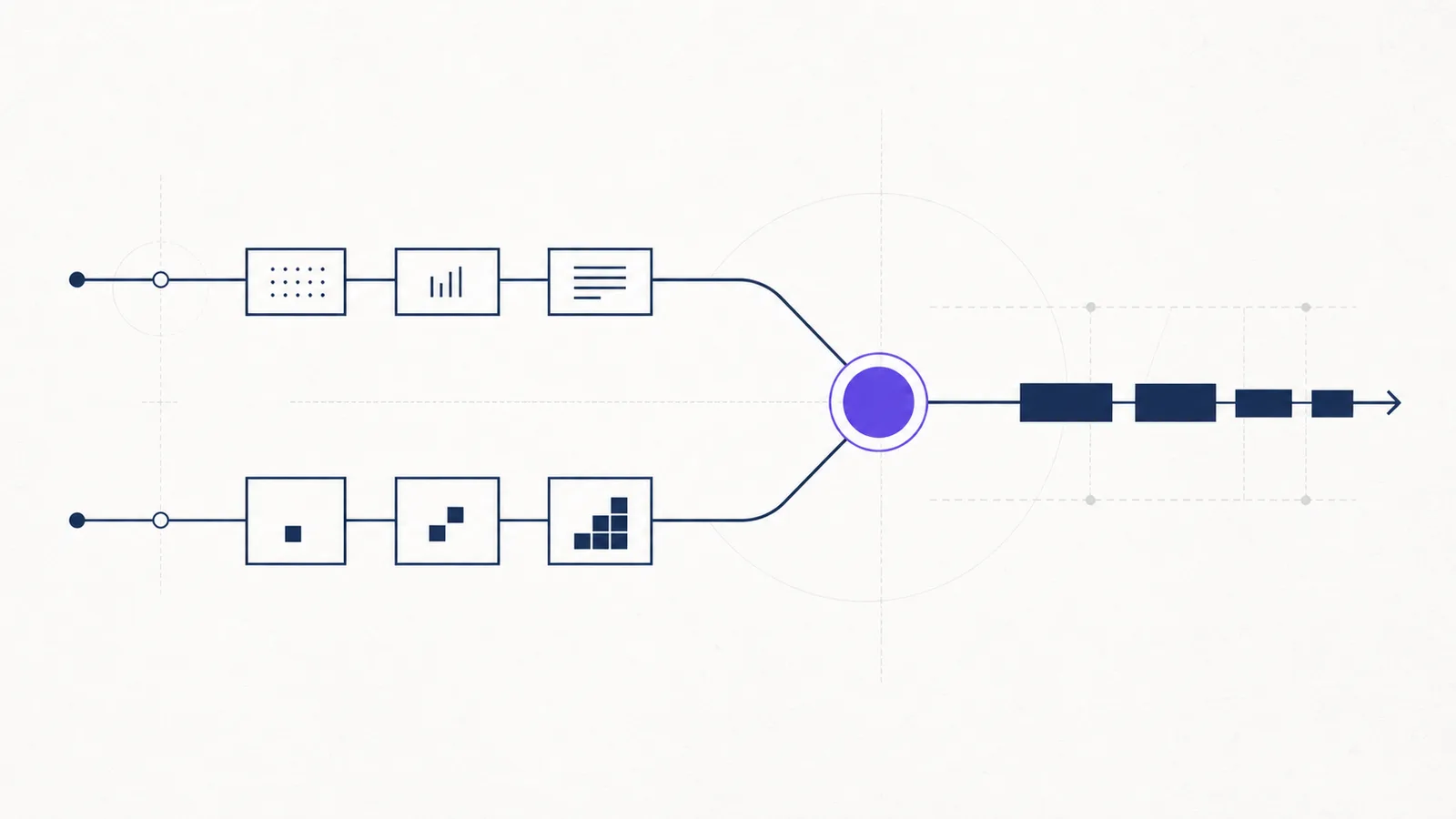
The consulting pyramid was never really about wisdom at the top. It was a cost structure. The product a client bought was a partner's judgement, but manufacturing that judgement — the research, the benchmarking, the modelling, the hundred-slide appendix — was expensive, so firms spread the cost across tiers of junior analysts and billed for the hours. The pyramid existed to amortise the cost of analysis. The client, knowingly or not, paid for headcount.
AI has collapsed that cost. Not to zero, and not evenly — but far enough that the economics invert. When a senior practitioner with the right systems can produce in days the analysis that once took a team of juniors a month, a firm built to bill the month is structurally mispriced. What follows is our operating thesis, written from the build side of the business: what "AI-native" honestly means, what the marketing version looks like, and what a client should demand as proof before paying anyone's day rate.
Key takeaways
- The pyramid existed to amortise the cost of analysis across junior labour. AI removes most of that cost, so the economics of consulting invert: small senior teams deliver faster, and the client pays for judgement, not headcount.
- The evidence is field-experimental, not anecdotal: in the Harvard/BCG study, consultants using GPT-4 finished tasks 25.1% more quickly at over 40% higher quality — and were 19% less likely to be right on a task outside the model's competence.
- "AI-native" honestly means an operating model built on AI from inception. A tools rollout with a rebrand is not it, however the deck describes it.
- The proof to demand: the firm ships its own AI systems, the seniors do the work, the timeline is weeks rather than quarters, and a named person is accountable for every output.
- The sceptic's case is partly right — Gartner expects over 40% of agentic AI projects to be cancelled by the end of 2027 — and human accountability for AI work is precisely the product an AI-native firm sells.
What the pyramid billed for, and what AI now does
The traditional firm sold three things bundled as one price: analysis (the labour-intensive middle), access (the partner's relationships and pattern recognition), and accountability (a name on the report your board could rely on). The pyramid was the manufacturing system for the first of these. Juniors gathered the data, built the models and drafted the decks; managers checked the work; partners sold it and signed it. Leverage ratios — many juniors per partner — were the profit engine, and the billable hour was its meter.
AI eats the middle of that bundle. Harvard Business Review's September 2025 analysis, AI Is Changing the Structure of Consulting Firms, describes exactly this: AI now automates the research, modelling and analysis junior consultants were hired to produce, flattening the pyramid into what the authors call an "obelisk" — fewer layers, smaller teams, senior experts working directly with AI systems. The incumbents' own numbers make the point: HBR reports that McKinsey's internal assistant Lilli is used by over 72% of its workforce and has cut research and synthesis time by around 30%.
The capability gain underneath that restructuring has been measured, not asserted. In the Harvard/BCG field experiment — Dell'Acqua et al., "Navigating the Jagged Technological Frontier", since published in Organization Science — 758 BCG consultants worked through 18 realistic consulting tasks. Those given GPT-4 completed 12.2% more tasks, finished them 25.1% more quickly, and produced work the working paper assessed at more than 40% higher quality than the control group. For work within the model's competence, the augmentation is not marginal. It replaces the labour the pyramid existed to organise.
Clients have noticed. City AM's reporting on consulting's reckoning describes a UK market that contracted from £15.4bn to £14.9bn in 2024, clients adopting AI in-house faster than their advisers, and firms cutting the junior intake that fed the old model. What buyers say they still want is the one thing AI does not supply: experienced people with proven judgement, accountable when it matters. That preference is the inversion in miniature. Analysis is becoming abundant; judgement remains scarce; clients increasingly want to pay for the scarce thing.
"AI-native" has an honest definition — and a marketing one
Every firm now claims the label, which makes it worth defining before it dies of overuse.
The honest definition: an AI-native consultancy is one whose operating model was built on AI from inception. There is no junior tier whose billable hours the technology threatens, because the firm never hired one. There is no hourly revenue line that efficiency cannibalises, because the work was priced on outcomes from day one. Delivery, staffing and pricing all assume the machine does the analysis and the human owns the judgement — so when the models improve, the firm gets faster and the client gets cheaper, and nobody in the building is harmed by that.
The marketing version is a tools rollout wearing the same label: the existing pyramid, the existing rate card, plus copilot licences and an innovation lab. The difference is not cynicism, it is incentives. A firm that bills by the hour is penalised by its own efficiency; every productivity gain is revenue it must choose to give up. That is a hard choice for a partnership built on leverage ratios, and the rational outcome is adoption theatre — AI in the brochure, the pyramid in the engagement letter.
There is a one-question test: what happens to this firm's economics when the work gets faster? If the answer is "margins improve and the client's price falls", the firm is AI-native. If the answer is "revenue falls", you are looking at a pyramid with a new name, and its incentives are not your incentives. We set out how we run on the model side of this line — and what it changes about scoping and price — on our AI-native page.
If you are comparing buying routes, read this alongside AI governance consultancy versus build shop, AI governance software versus consultancy, and AI governance consultancy pricing in the UK. The operating-model question only matters once the board is clear whether it needs judgement, software, implementation or all three.
The proof a client should demand
Claims are free, so the useful due diligence is structural. Four questions separate the operating model from the rebrand.
- Does the firm ship its own AI systems? Advice about AI from people who have never carried a system into production is theory. A firm that runs its own builds has felt where models fail, what controls hold, and what the last 20% costs. Ours are documented in our case studies — property operations, surveying, insolvency intelligence — and in the platform we operate ourselves.
- Do the seniors do the work? In the pyramid, the partner sells and the juniors deliver. In an AI-native firm there is no junior layer to delegate to: the people on the website are the people in the engagement. Ask who, by name, will produce your work — and how many other engagements they are on.
- Is the timeline weeks or quarters? If the cost of analysis has collapsed, duration should have collapsed with it. A diagnostic that takes two quarters is billing you for a pyramid whether or not one still exists. Our GovernIQ diagnostics start from £3,950 and are scoped in weeks, because the analysis is no longer the bottleneck — the judgement is. The AI governance diagnostic cost guide explains what should change the scope.
- Who carries accountability for the outputs? This is the question that matters most, and the one a tools rollout cannot answer. If AI drafted the analysis, who checked it, who signed it, and what evidence of that sign-off survives? A firm should be able to show you the control, not describe it. Ours are on the trust page.
The sceptic's case, named and owned
There is a fair objection to all of this: most of it will fail. Gartner predicts that over 40% of agentic AI projects will be cancelled by the end of 2027, citing escalating costs, unclear business value and inadequate risk controls. And the jagged-frontier study cuts both ways: the same experiment that found 40% quality gains also found that consultants using AI were 19% less likely to produce a correct answer on a task deliberately chosen to sit just outside the model's competence — with the model's fluency making the wrong answers more persuasive, not less.
We think both findings are correct, and neither is an argument against the thesis. They are the thesis. The leverage is real and it fails at the boundary of the model's competence — which means the leverage only works under governance. The naive reading of the inverted pyramid is "remove the humans"; the evidence says the opposite. The obelisk keeps its seniors precisely because someone has to know where the frontier sits, catch the persuasive wrong answer, and carry the outcome when the model cannot. Human accountability for AI work is not overhead on the product. It is the product. We have written separately about why AI projects fail; the short version is that they fail at exactly this boundary, for want of exactly this accountability.
Governing AI with AI, under the controls we sell
For governance work in particular, the thesis is recursive: a firm advising boards on AI accountability had better be able to evidence its own. Our research, drafting and evidence pipelines run on AI under the same controls we engineer for clients — a named person signs off before anything leaves the building, claims are checked against their sources, and the record of who approved what is kept append-only. AI assistance is disclosed, as it is on this very article. We hold ourselves to the standard because the alternative — selling controls we do not run — is the consulting failure mode the Intelligence Age punishes first.
The pyramid was not a con. It was a rational answer to the cost of analysis in its time, and it built the profession. But the cost it was designed to amortise has fallen away, and a cost structure cannot outlive its cost. What replaces it is smaller, faster and more exposed: senior people, accountable by name, with machine leverage underneath them and engineered controls around it. The firms that thrive will be the ones that re-price honestly — charge for judgement and accountability, let the machine do the analysis, and prove the difference rather than assert it.
Last reviewed: 12 June 2026.
If you are choosing an adviser for AI work, put the four questions above to every firm on your shortlist — including us. See how we operate as an AI-native consultancy, what we offer as an AI governance consultancy, who does the work, the systems we have shipped, and the controls we hold ourselves to.